The big picture
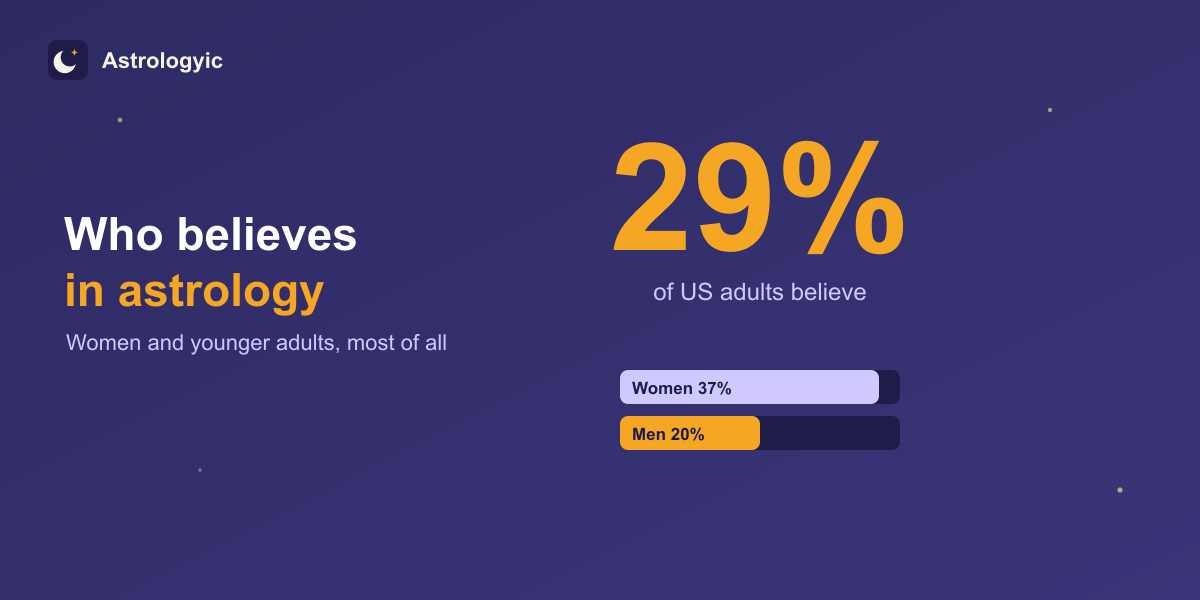
- Roughly 29% of US adults say they believe in astrology, according to the Pew Research Center.
- Astrology is one of the most common "New Age" beliefs, alongside psychics, reincarnation and spiritual energy.
- The majority of the world's population lives in a culture with a living astrological tradition: Western, Vedic or Chinese.
- There are 12 zodiac signs in Western astrology and 12 animal signs in the Chinese system.
- A full Western birth chart contains around 30 core placements across planets, signs and houses.
- Astrology is roughly 4,000 years old, dating to ancient Mesopotamia.
- Interest in astrology surged in the 2010s, driven by smartphone apps and social media.
- Astrology is consistently among the most-searched spirituality topics online worldwide.
- Belief in astrology has held broadly steady to rising in the US over the past two decades.
- Gallup polling has historically put US belief in astrology at around 25% of adults.
Who believes: the people
- About 37% of US women say they believe in astrology, versus roughly 20% of men (Pew Research Center).
- Women make up a clear majority of astrology app users and content audiences.
- Adults under 50 are notably more likely to believe than those 65 and older.
- Gen Z and millennials drive most of the recent growth in astrology engagement.
- Around 30% of US adults with some college education report believing in astrology.
- Belief is somewhat higher among adults who are religiously unaffiliated but is common among the religious too.
- Pew found New Age beliefs are held by majorities across most demographic groups in some form.
- People who identify as "spiritual but not religious" are among the most likely to follow astrology.
- LGBTQ adults report higher-than-average engagement with astrology in several surveys.
- A large share of believers say they read their horoscope mostly "for fun" rather than as literal truth.
- Many people who say they "don't believe" in astrology still know their Sun sign.
- Knowing your Sun sign is near-universal in many countries, even among skeptics.
- Younger women are the single most astrology-engaged demographic in most studies.
- Surveys suggest a meaningful minority of adults have made a decision influenced by a horoscope.
- Compatibility by sign is one of the most popular reasons people first look into astrology.
- A significant share of daters say a partner's zodiac sign matters at least a little to them.
- Belief tends to be lower among adults with postgraduate degrees, but is far from absent.
- Political independents and liberals report slightly higher astrology belief than conservatives in US polling.
- Parents often introduce children to Sun signs early, keeping the tradition generational.
- Horoscope columns remain among the most-read sections of many newspapers and news apps.
- A notable share of people check their horoscope daily or weekly.
- Stress and uncertainty correlate with spikes in astrology interest, including during the early 2020s.
- Many users turn to astrology for self-reflection and identity, not prediction.
- "What's your sign?" remains one of the most recognized questions in pop culture worldwide.
- Women 65%
- Men 35%
By country and region
- India has one of the largest astrology economies on Earth, deeply tied to marriages, naming and business timing.
- A majority of Indian families consult astrology for wedding-date selection (muhurta).
- India's astrology industry is frequently estimated in the billions of dollars annually.
- China's zodiac shapes real demographics: Dragon years often see measurable baby booms.
- Chinese astrology runs on a 12-year animal cycle combined with five elements over 60 years.
- Astrology and almanacs remain widely consulted across East and Southeast Asia.
- In the United Kingdom, roughly a quarter of adults say they believe in astrology in various polls (YouGov).
- Latin American countries tend to report relatively high astrology belief and daily horoscope reading.
- Highly secular Nordic countries tend to report lower astrology belief than the global average.
- Astrology belief appears across every continent, varying widely by culture.
- In the US, belief rates are broadly similar across most regions, with modest variation.
- Brazil has a large and active astrology media and practitioner scene.
- Astrology features prominently in media across Russia and Eastern Europe.
- Many Middle Eastern and South Asian cultures maintain strong traditional astrology practices.
- Thailand, Myanmar and Sri Lanka have prominent traditional astrology in public life.
- Newspaper horoscopes are a daily fixture in dozens of countries and languages.
- Vedic astrology (Jyotisha) is practiced by hundreds of millions across the Indian subcontinent and diaspora.
- The Chinese zodiac is recognized by well over a billion people worldwide.
- Astrology apps have pushed Western Sun-sign astrology into markets that historically used other systems.
- Belief in astrology is often higher in countries with strong folk-spiritual traditions.
- Global search interest in "horoscope" and "zodiac" spans virtually every country.
- Diaspora communities frequently keep their home tradition's astrology alive abroad.
- Cross-cultural studies find astrology among the most globally widespread belief systems.
- Many national cultures pair astrology with almanacs for farming, festivals and auspicious dates.
| Region | Common system | Belief / engagement |
|---|---|---|
| United States | Western (Sun-sign) | ~29% believe (Pew) |
| United Kingdom | Western | ~1 in 4 adults |
| India | Vedic (Jyotisha) | Very high, multi-billion industry |
| China & East Asia | Chinese zodiac | Near-universal cultural awareness |
| Latin America | Western | High daily horoscope reading |
| Nordic Europe | Western | Below global average |
The industry and money
- Astrology is part of a multi-billion-dollar global "mystical services" market.
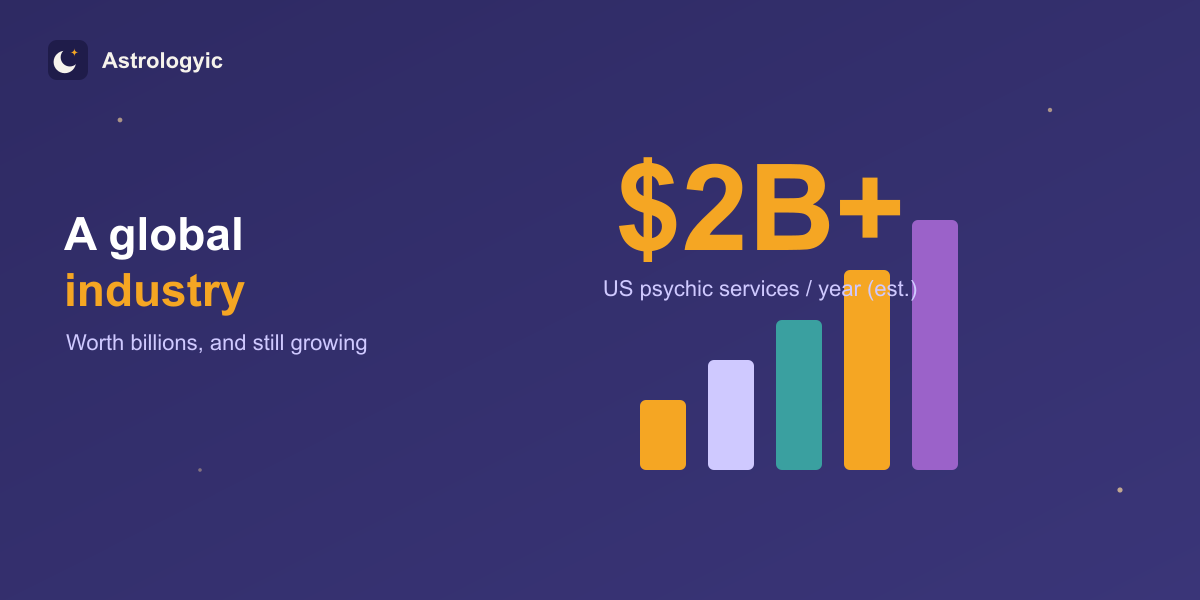
- US psychic services revenue is estimated at over $2 billion per year (industry analysts such as IBISWorld; see also Statista).
- The astrology and psychic-services sector has shown steady growth over the past decade.
- Astrology has expanded from columns and hotlines into apps, subscriptions and one-to-one readings.
- A single personal birth-chart reading from a professional astrologer can range from roughly $50 to $300+.
- Some celebrity and high-demand astrologers charge several hundred dollars or more per session.
- Astrology apps commonly monetize through subscriptions of a few dollars a month.
- The broader "spiritual wellness" market that astrology sits within is valued in the tens of billions.
- India alone is often cited as a multi-billion-dollar astrology market by local business media.
- Wedding and event timing is one of astrology's largest commercial use cases in South Asia.
- Corporate and financial "astro" newsletters are a small but persistent niche.
- Astrology has spawned product lines: candles, journals, decks, jewelry and birth-chart prints.
- Birthstones, tied to the zodiac calendar, feed a large jewelry sub-market.
- Media companies run astrology verticals because horoscopes drive reliable repeat traffic.
- Freelance astrologers operate on global marketplaces charging per-minute and per-reading rates.
- Astrology events, workshops and courses form a growing education sub-industry.
- Many astrologers now earn primarily through online courses and memberships.
- The pandemic era accelerated spending on astrology apps and remote readings.
- Venture capital has flowed into several astrology startups since the late 2010s.
- Astrology's commercial appeal is its habit loop: a reason to return daily.
- Print almanacs with astrological content still sell in large numbers in some markets.
- Astrology merchandising is a staple of the broader Gen Z spirituality economy.
Apps, digital and search
- The astrology app Co-Star has been downloaded tens of millions of times.
- Co-Star raised multimillion-dollar venture funding to scale its hyper-personalized horoscopes.
- The Pattern went viral partly through celebrity endorsements.
- Astrology apps personalize using your exact birth date, time and place, the same inputs as a full birth chart.
- App-store "lifestyle" charts regularly feature multiple astrology apps in top rankings.
- Searches for "Mercury retrograde" spike several times a year, every year.
- "Horoscope today" is among the most repeated daily searches in many countries.
- Astrology memes are a massive, self-sustaining genre on social media.
- Short-video platforms have made per-sign content ("the signs as...") a viral format.
- Push-notification horoscopes drive some of the highest open rates in lifestyle apps.
- Compatibility features are among the most-used tools in astrology apps.
- Birth-chart calculators are among the most-searched free astrology tools online.
What science says
- Astrology is classified by scientists as a pseudoscience; its core claims fail controlled tests.
- A landmark 1985 study in Nature found astrologers performed no better than chance at matching charts to people.
- NSF Science and Engineering Indicators have tracked how many people consider astrology "scientific", historically a large minority.
- Younger respondents have at times been more likely than older ones to call astrology "sort of scientific".
- The Barnum effect explains why vague horoscopes feel personally accurate.
- Sun-sign columns apply to about one-twelfth of the entire planet at once.
- Belief and spending keep rising despite the lack of scientific support, which is a finding in itself.
- The honest takeaway: astrology is culturally huge and personally meaningful to millions, even though it is not a science. Curious where you fit in? Cast your free chart or read 100 facts about astrology.
Frequently asked questions
What percentage of people believe in astrology?
In the United States, about 29% of adults say they believe in astrology, according to the Pew Research Center, with other polls landing in a similar 25–30% range. Belief is higher among women and younger adults, and rates vary widely by country.
How big is the astrology industry?
Astrology sits within a multi-billion-dollar global market for mystical and spiritual-wellness services. The US psychic-services sector alone is estimated at over $2 billion a year, and countries like India have their own multi-billion-dollar astrology economies.
Who is most likely to believe in astrology?
Women and adults under 50 are the most likely to believe, with younger women the single most engaged group. People who describe themselves as "spiritual but not religious" also report high engagement.
Is astrology scientifically proven?
No. Astrology is classified as a pseudoscience, and controlled studies, including a famous 1985 test published in Nature, have not found evidence that it predicts personality or events. Many people still find it meaningful as a framework for reflection.
 The Zodiac Signs of the World's Billionaires
 Astrology App Statistics 2026: Downloads, Users & Revenue
 The Zodiac Signs of Every US President: The Complete Ranked List