Origins and history
- Astrology was born in ancient Mesopotamia (modern Iraq) around 4,000 years ago, where Babylonian priests recorded the movements of the planets as omens. See the Encyclopaedia Britannica overview for the long view.
- The earliest astrology was about the fate of kings and nations, not individuals. Personal horoscopes came much later.
- The familiar 12-sign zodiac took shape in Babylon around the 5th century BCE, dividing the sky into 12 equal slices of 30 degrees each.
- The word "zodiac" comes from the Greek zodiakos kyklos, meaning "circle of little animals".
- Ancient Egypt blended its own star lore with Babylonian ideas, and the famous Dendera zodiac, carved on a temple ceiling, still survives today, though the original was removed and now hangs in the Louvre in Paris.
- The Greeks turned astrology into a personal system. Around the 2nd century CE, Claudius Ptolemy wrote the Tetrabiblos, the text that shaped Western astrology for over a thousand years.
- For most of history, astrology and astronomy were a single craft. The same scholars who mapped the planets also read their meanings.
- Astrology was taught at major medieval universities and was considered a serious scholarly subject.
- Many famous early scientists practiced astrology, including Johannes Kepler, who cast horoscopes while discovering the laws of planetary motion.
- The word "disaster" comes from the Italian disastro, literally "bad star", a fossil of how deeply astrology shaped language.
- "Influenza" took its name from the Italian word for "influence", an illness once blamed on the influence of the stars.
- Astrology declined in Western intellectual life from the 1600s as the scientific revolution and the telescope reshaped how people understood the sky.
- c. 2000 BCEBabylonian priests record planetary omens for kings
- c. 5th C BCEThe 12-sign zodiac is standardized in Babylon
- c. 2nd C CEPtolemy writes the Tetrabiblos in Alexandria
- Middle AgesAstrology is taught in European universities
- 1600sThe scientific revolution splits astronomy from astrology
- 1930The first modern newspaper horoscope column appears
- 2010sApps and social media spark a global astrology revival
The zodiac signs
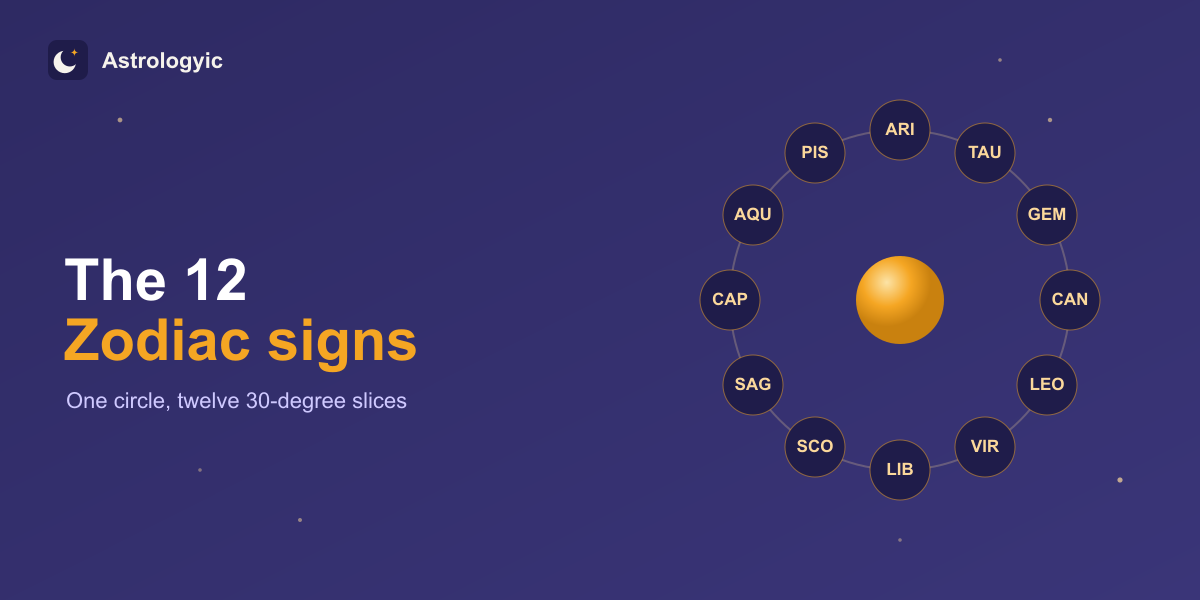
- There are 12 zodiac signs, each tied to roughly a month-long stretch of the year: Aries, Taurus, Gemini, Cancer, Leo, Virgo, Libra, Scorpio, Sagittarius, Capricorn, Aquarius and Pisces.
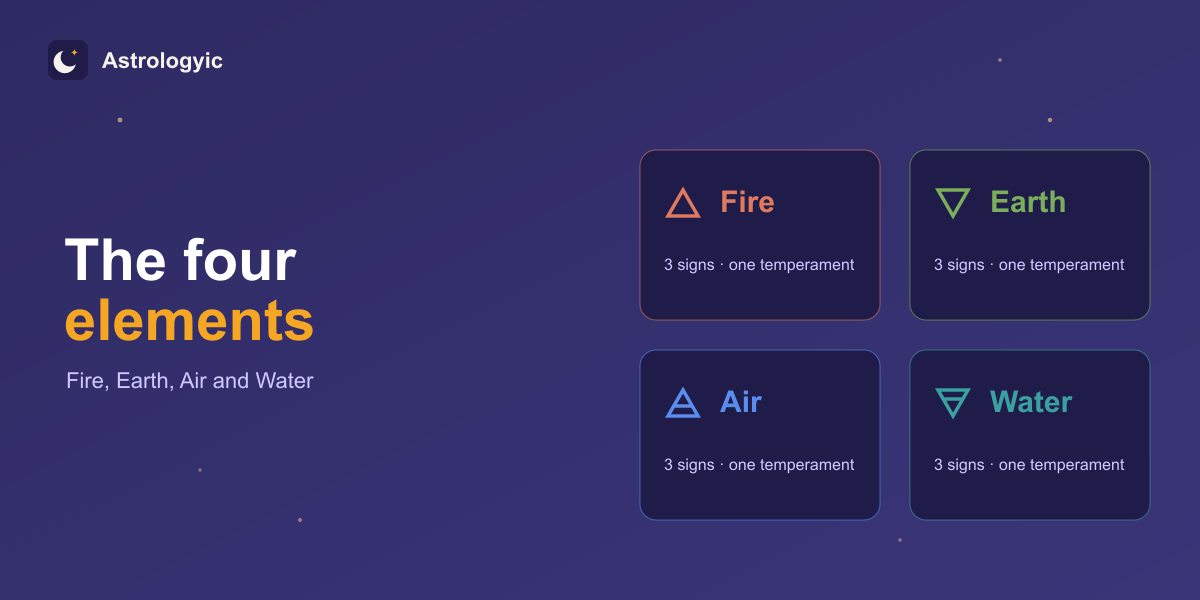
- Every sign belongs to one of four elements: Fire, Earth, Air or Water. The elements describe the basic temperament of a sign.
- Each sign also has a modality: Cardinal (initiators), Fixed (sustainers) or Mutable (adapters).
- The grid is perfectly balanced: four elements times three modalities equals exactly 12 signs, with no two signs sharing the same pair.
- Aries is the first sign of the zodiac because it traditionally began at the spring equinox.
- Each sign has a ruling planet. Leo is ruled by the Sun and Cancer by the Moon; the rest are ruled by the planets.
- Three signs are symbolized by humans (Gemini, Virgo, Aquarius), and the rest by animals or objects.
- Scorpio is the only sign with three symbols across traditions: the scorpion, the eagle and the phoenix.
- The dates for each sign shift by up to a day from year to year, because the calendar and the Sun's motion do not line up perfectly.
- If you were born on the edge of two signs, you are said to be "on the cusp", though in practice you are still one sign or the other.
- Opposite signs (like Aries and Libra) are thought to be two halves of one axis, sharing a theme from opposite angles.
- Signs of the same element are considered naturally compatible, which is the starting point most compatibility readings build on.
- The symbol or "glyph" for each sign is a piece of shorthand astrologers have used for centuries.
- Your Sun sign is the one almost everyone knows, but it is just the beginning of the chart.
- Fire25%
- Earth25%
- Air25%
- Water25%
Planets, houses and the birth chart
- Your full birth chart is a snapshot of the sky at the exact moment and place you were born, with around 30 distinct placements.
- The "Big Three" most astrologers start with are your Sun (core self), Moon (emotions) and Rising sign. You can find all three with the Big Three calculator.
- Your Sun sign needs only your birth date, but your Moon and Rising signs need your exact birth time and place.
- The Rising sign, or Ascendant, is the sign that was climbing over the eastern horizon at your birth, and it changes roughly every two hours.
- Traditional astrology used seven "planets": the Sun, Moon, Mercury, Venus, Mars, Jupiter and Saturn, all visible to the naked eye.
- Uranus, Neptune and Pluto were added to Western astrology only after telescopes discovered them, in 1781, 1846 and 1930.
- The Sun and Moon are called "luminaries" rather than planets, since they are the two great lights of the sky.
- Each planet governs a theme: Venus love and values, Mars drive and conflict, Mercury the mind and communication.
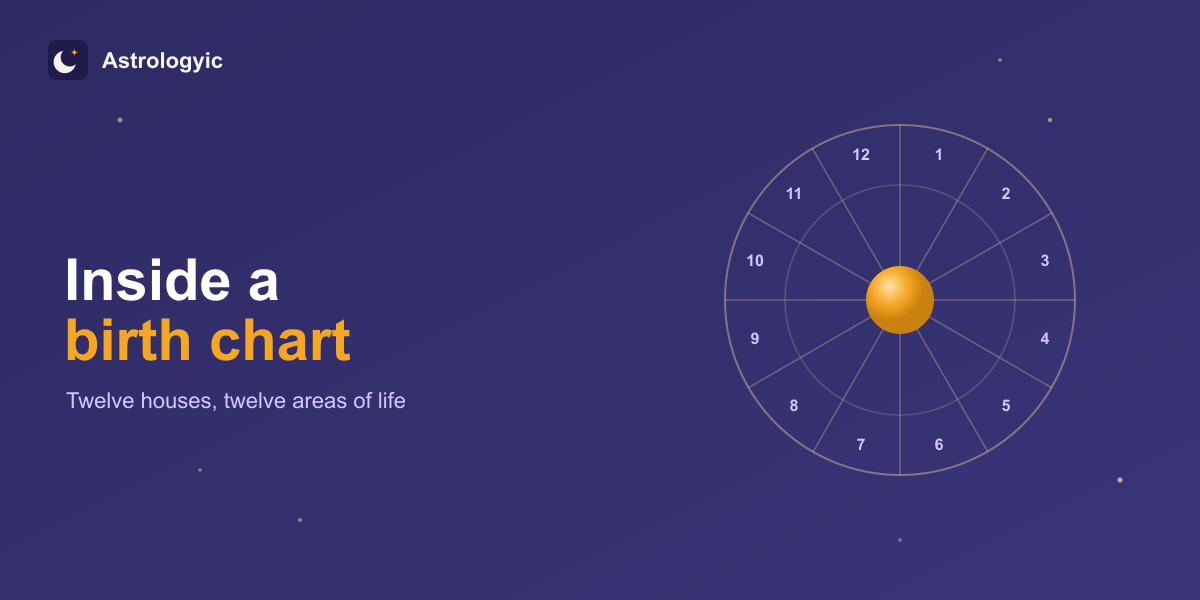
- The chart is divided into 12 houses, each covering an area of life such as money, home, career or relationships.
- Where signs describe how an energy behaves, houses describe where in your life it shows up. You can map yours with the houses checker.
- The angles planets make to each other are called aspects: a trine is harmonious, a square is tense, an opposition is a tug of war.
- A "stellium" is three or more planets clustered in one sign or house, concentrating its energy.
- When a planet appears to move backward from Earth, it is "retrograde", an optical effect of orbital speeds, not an actual reversal.
- Mercury goes retrograde three or four times a year, which is why it gets blamed so often.
- 1Birth momentYour exact date, time and place fix the sky overhead.
- 2Planet positionsEach planet is placed in a zodiac sign by its longitude.
- 3The AscendantThe sign rising in the east anchors the chart and the houses.
- 4Houses and aspectsThe chart is split into 12 houses, and the angles between planets become aspects.
Western, Vedic and Chinese traditions
- There is no single astrology. The three biggest living traditions are Western, Vedic (Indian) and Chinese.
- Western astrology uses the "tropical" zodiac, tied to the seasons and the equinoxes rather than the current star positions.
- Vedic astrology, or Jyotisha, uses the "sidereal" zodiac, tied to the actual constellations, so the signs sit about 24 degrees apart from Western ones.
- Because of that difference, many people are a different sign in Vedic astrology than in Western astrology.
- Chinese astrology runs on a 12-year animal cycle (Rat, Ox, Tiger and so on) rather than monthly signs.
- Chinese astrology also pairs each year with one of five elements, creating a 60-year cycle before any combination repeats.
- Mayan, Tibetan, Celtic and Aztec cultures all developed their own distinct astrological systems.
- Astrology appears, in some form, across nearly every literate ancient civilization, an example of cultures reaching similar ideas independently.
- Western astrology focuses heavily on the psychological self; Vedic astrology leans more toward fate, timing and remedies.
- Horary astrology is a branch that answers a specific question from the chart of the moment the question is asked.
- Electional astrology picks the most favourable time to start something, from a wedding to a business launch.
- Astrology has no central authority or single rulebook, which is why traditions and astrologers often disagree.
Astrology and the real sky
- Astrology and astronomy began as one subject but are now entirely separate: astronomy is a physical science, astrology is a symbolic system.
- Because of a slow wobble in Earth's axis called precession, the zodiac signs no longer line up with the constellations they were named after. NASA explains the difference between constellations and astrology.
- Precession means the sky has drifted about one full sign since the zodiac was fixed roughly 2,000 years ago.
- There is a 13th constellation the Sun passes through, Ophiuchus, but Western astrology deliberately keeps 12 even signs, not 13 constellations.
- The tropical zodiac most Westerners use is not based on the constellations at all, but on the Sun's position relative to the seasons.
- Constellations are wildly different sizes in the sky, while zodiac signs are all an equal 30 degrees, another sign that signs are a human grid, not a map of the stars.
- The Moon moves the fastest of all chart bodies, changing sign every two to three days.
- Pluto was reclassified by astronomers as a "dwarf planet" in 2006, but most astrologers still use it.
- The planets do exert real gravity, but the gravitational pull of the doctor delivering a baby is greater than that of Mars at birth.
- The constellations are chance line-of-sight patterns; their stars are often hundreds of light years apart, not physically grouped.
- The same word "house" means something completely different in astronomy and astrology, a common source of confusion.
- Telescopes, space probes and modern astronomy grew directly out of the careful sky records that early astrologers kept.
- A symbolic system of meaning
- Signs, houses and aspects
- Interpretation and tradition
- Thousands of years old
- The physical science of space
- Stars, planets, galaxies and physics
- Measurement and testable theory
- A modern empirical science
Science, skepticism and studies
- Astrology is classified by scientists as a pseudoscience, because its core claims have not held up under controlled testing.
- In a landmark 1985 study published in Nature, physicist Shawn Carlson ran a double-blind test and found astrologers could not match charts to personality profiles better than chance.
- The "Barnum effect" explains part of astrology's appeal: people rate vague, flattering descriptions as highly accurate about themselves.
- In classic experiments, people handed the same generic horoscope rated it as remarkably accurate for them personally.
- Large analyses of birth season and personality have found no meaningful link of the kind astrology predicts.
- Sun sign columns are written to apply to one twelfth of the entire planet at once, which is statistically a very broad net.
- Confirmation bias means we remember the predictions that hit and quietly forget the ones that miss.
- Astrologers given anonymized real charts in tests have generally been unable to agree with each other on the same person.
- None of this stops astrology from being meaningful to people as a language for reflection, which is a separate question from whether it predicts events.
- Scientific bodies, including a famous 1975 statement signed by 186 scientists, have publicly objected to astrology.
- Many astrologers themselves describe their practice as a tool for insight and storytelling rather than literal prediction.
- The honest position is simple: enjoy astrology as meaning or as a mirror, but do not use it to replace evidence for big life decisions.
Astrology in culture and daily life
- The first modern newspaper horoscope column appeared in 1930, written by R.H. Naylor for the British Sunday Express to mark the birth of Princess Margaret.
- That single column was so popular it launched the daily horoscope as a permanent newspaper feature.
- Astrology saw a huge revival in the 2010s, driven by apps, memes and social media.
- The astrology app and services market has grown into a multi-billion-dollar global industry.
- "What's your sign?" became such a common pickup line that it is now a cultural cliche of the 1970s.
- US President Ronald Reagan's schedule was reportedly shaped in part by an astrologer during his time in office.
- Astrology is woven into language we use daily, from "lunatic" (from luna, the Moon) to "mercurial" and "jovial" (from Jupiter, or Jove).
- The days of the week are named for the seven classical planets in many languages: Saturday for Saturn, Sunday for the Sun, Monday for the Moon.
- Birthstones, long tied to the calendar and the zodiac, are a direct descendant of astrological tradition.
- Astrology is especially popular with younger adults and is more widely embraced by women than men in most surveys.
- Compatibility by sign is one of the most searched astrology topics in the world, fuelling endless "best and worst match" lists.
- Daily horoscopes remain one of the most-read sections of many news sites, decades after that first 1930 column.
Curious and surprising facts
- Numerology often travels alongside astrology, assigning each number a planet, which is why you can find your Life Path number the same way you find your sign.
- The Sun spends about a month in each sign, but the exact moment it changes can shift by several hours from year to year.
- Identical twins born minutes apart can technically have slightly different charts, especially a different Ascendant degree.
- There is no scientifically agreed "luckiest" sign, despite countless articles claiming otherwise.
- The glyphs for the planets are ancient symbols still used today in both astrology and astronomy.
- Some companies in the 20th century quietly experimented with astrology in hiring, a practice with no evidence behind it.
- The phrase "born under a lucky star" and the very idea of a personal "star" both come straight from astrology.
- Astrology's symbols appear everywhere in art, from medieval cathedral floors to modern tattoos.
- The tropical zodiac is so embedded in culture that most people who say their sign have no idea it no longer matches the constellation.
- Learning to read a chart yourself is very different from reading a horoscope; one is a skill, the other is a summary. You can start with our free course.
- Astro Logyic's whole approach is to show the reasoning behind every placement, so you can judge it for yourself rather than take it on faith.
- The most useful fact of all: your Sun sign is one line of a thirty-line story, so cast your full chart before you decide what astrology says about you.
Frequently asked questions
Is astrology real?
Astrology is real as a 4,000-year-old cultural and symbolic system, and it is meaningful to millions of people. It is not, however, supported by scientific evidence as a way to predict personality or events. Both things are true at once.
What is the difference between astrology and astronomy?
Astronomy is the physical science of space: stars, planets and galaxies, studied with measurement and testable theory. Astrology is a symbolic system that reads human meaning into the positions of those same bodies. They share a history but are now separate fields.
Is my Sun sign my whole astrology?
No. Your Sun sign is one of around thirty placements in your birth chart. Your Moon, Rising and every planet add their own layer, which is why two people with the same star sign can be so different. Cast your free chart to see the rest.
How many zodiac signs are there?
There are 12 zodiac signs in Western astrology, split evenly across four elements and three modalities. A 13th constellation, Ophiuchus, sits on the Sun's path, but Western astrology keeps a tidy grid of 12 equal signs rather than following the uneven constellations. </content> </invoke>
 The Zodiac Signs of the World's Billionaires
 Astrology App Statistics 2026: Downloads, Users & Revenue
 The Zodiac Signs of Every US President: The Complete Ranked List