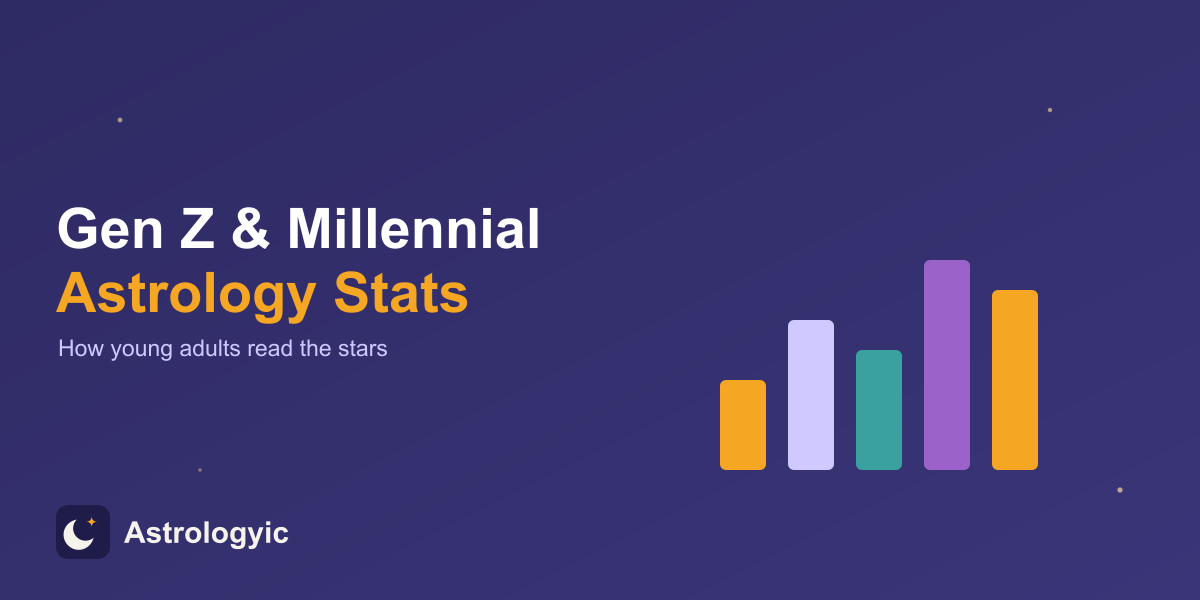
How many young people actually believe in astrology
Belief numbers vary by how you ask the question, so treat every figure as a range, not a hard line. Still, the pattern is consistent across major pollsters: younger adults engage more than older ones.
- The Pew Research Center reports that about 30 percent of US adults consult astrology, tarot cards, or fortune tellers at least once a year, and that about 27 percent say they believe in astrology specifically. You can review the broader work at the Pew Research Center.
- Pew data also suggests belief is higher among adults under 50 than among those 50 and older, and higher among women than men.
- YouGov polling has found that roughly a quarter of US adults say they believe in astrology, with younger respondents over-represented. See the latest YouGov polling.
- Gallup's long-running trend work has historically put belief in astrology at around 25 percent of US adults, a figure that stayed in roughly that band across its polls. More in Gallup's trend data.
If you want to check where your own placements sit before reading further, the big three calculator and the astrology sign checker are quick starting points.
Women, men, and the persistent gender gap
Across almost every survey, women report more belief and more engagement than men. This gap shows up in nearly all age groups but is widest among younger adults.
- YouGov and Pew surveys both suggest women are roughly twice as likely as men to say they believe in astrology.
- Pew's 2024 survey found that about 43 percent of women ages 18 to 49 say they believe in astrology, compared with about 20 percent of men the same age, 27 percent of women 50 and older, and 16 percent of older men.
- Astrology app user bases skew female, with several app makers reporting that an estimated 70 to 80 percent of their active users are women.
| Group | Approx. share reporting belief | Source type |
|---|---|---|
| Women 18-49 | around 43% | Pew 2024 survey |
| Men 18-49 | around 20% | Pew 2024 survey |
| Women 50+ | around 27% | Pew 2024 survey |
| Men 50+ | around 16% | Pew 2024 survey |
| Adults 50+ (all) | around 20-25% | Gallup / Pew |
If compatibility is what pulls you in, the compatibility tool and sign pages like Aries, Gemini, and Scorpio are popular entry points for younger readers comparing charts with friends and partners.
"Spiritual but not religious" is the bigger story
Astrology's rise tracks closely with a broader shift away from organized religion and toward personal, flexible spirituality.
- Pew Research Center estimates that around 22 percent of US adults, roughly 1 in 5, now identify as "spiritual but not religious," a share that has grown over the past few decades.
- The same body of research suggests the religiously unaffiliated, sometimes called the "nones," make up an estimated 28 to 30 percent of US adults, and that group skews young.
- Among adults who are spiritual but not religious, belief in astrology runs well above the national average, by some estimates closer to 40 to 50 percent.
For many younger users, astrology is not a competing religion. It is a vocabulary for self-reflection that fits alongside therapy language, journaling, and wellness routines.
- Self-knowledge / personality tool 65%
- Literal predictive belief 35%
You can read more cultural context in our roundups, 100 statistics about astrology and 100 facts about astrology.
Apps, downloads, and spending
The clearest sign of generational engagement is money and screen time. Astrology went from newspaper columns to a software category.
- Market trackers and Statista estimates put the global "mystic services" and astrology app market in the hundreds of millions of dollars in annual revenue by the early 2020s, with projections into the low billions later this decade.
- Leading astrology apps have reported cumulative downloads in the tens of millions, with the largest single apps citing an estimated 10 to 30 million downloads or registered users.
- Industry reporting suggests a meaningful minority of young users, perhaps an estimated 10 to 20 percent of regular app users, have paid for a reading, a premium subscription, or a one-to-one consultation.
- Per-reading prices vary widely, from a few dollars for an app feature to an estimated 50 to 300 dollars or more for a detailed personal session with a professional astrologer.
- 2011Smartphone era begins; horoscope apps appear
- 2017Conversational astrology apps go viral with young users
- 2020Pandemic stress drives a sharp spike in downloads
- 2023Astrology content becomes a fixture on short-video platforms
If you would rather start free, you can build your full chart or skim the daily horoscope without spending anything.
TikTok, social media, and astrology content
Short-form video turned astrology from a private habit into a shared, public language for younger users.
- Hashtags such as #astrology and #zodiac have together accumulated an estimated tens of billions of views on TikTok, though exact platform totals are not reliably reported and shift over time. The audience is concentrated among users under 35.
- Survey readings suggest a large majority of Gen Z social users, by some estimates more than half, have seen astrology content in their feeds even if they do not follow it on purpose.
- Engagement tends to spike around events like Mercury retrograde periods and full moons, when search interest and posting both rise noticeably.
- Entertainment36%
- Self-understanding29%
- Social connection21%
- Genuine guidance14%
Why uncertainty and stress fueled the revival
The timing of the 2010s to 2020s boom is not random. Researchers and journalists repeatedly link rising astrology interest to economic anxiety, social instability, and mental-health stress among young adults.
- Surveys of Gen Z and Millennials consistently report high self-rated stress and uncertainty about the future, including jobs, housing, and climate.
- Psychology research on uncertainty suggests people lean toward belief systems that offer structure and meaning when they feel less in control, a pattern often cited to explain astrology's appeal.
- Reporting around the 2020 pandemic period noted sharp jumps in astrology app downloads and horoscope searches, consistent with stress-driven interest.
- Mood check and reflection
- Low stakes, high frequency
- Most common use
- Choosing dates or partners
- Higher stakes, lower frequency
- Less common use
Astrology as identity and self-care
For many younger users, astrology functions less like a forecast and more like a personality framework, similar to how others use enneagram or Myers-Briggs language.
- A large share of young engagers, by some estimates a majority, say they use astrology mainly for self-understanding rather than prediction.
- "What's your sign" has become social shorthand, with surveys suggesting most Gen Z adults know their sun sign and a growing minority know their moon and rising signs too.
- Astrology shows up in wellness routines alongside meditation and journaling, which is why it is often framed as self-care rather than fortune telling.
Sign pages like Leo and Pisces, plus the learn hub and the wider resources library, are built around this identity-first way of reading charts.
The science and skepticism note
Cultural popularity and scientific validity are different things, and the honest summary is that engagement is rising while the evidence base is not.
- Controlled studies, including the often-cited Shawn Carlson study published in Nature in 1985, found that astrologers could not match birth charts to personality profiles better than chance.
- Scientific bodies broadly classify astrology as a belief system rather than a science, citing no known mechanism and no reliable predictive results.
- Researchers point to the Barnum or Forer effect, where vague, flattering descriptions feel personally accurate to almost anyone, as a key reason horoscopes feel convincing.
Frequently asked questions
Do Gen Z and Millennials really believe in astrology more than older generations?
Yes, surveys consistently point that way. Pew Research Center and YouGov data suggest belief is higher among adults under 50, and Pew finds that about 30 percent of US adults consult astrology, tarot, or fortune tellers at least yearly while about 27 percent say they believe in astrology. The youngest adults report the highest engagement, though much of it is casual rather than literal belief.
Are women more into astrology than men?
In almost every survey, yes. Pew's 2024 data shows about 43 percent of women ages 18 to 49 believe in astrology versus about 20 percent of men the same age, roughly a two-to-one gap. Astrology apps often report that an estimated 70 to 80 percent of their users are women. The gap appears across age groups but is widest among younger adults.
How big is the astrology app market?
Market estimates, including Statista projections, put global mystic-services and astrology app revenue in the hundreds of millions of dollars per year by the early 2020s, with forecasts reaching the low billions later this decade. Leading apps report cumulative downloads in the tens of millions, and a minority of users pay for premium features or readings.
Is there scientific evidence that astrology works?
No reliable evidence supports astrology as a predictive system. The 1985 Carlson study in Nature and later reviews found results no better than chance, and scientific bodies treat astrology as a belief system rather than a science. Many people still find value in it for reflection and self-understanding, which is a separate question from predictive accuracy.
 The Zodiac Signs of the World's Billionaires
 Astrology App Statistics 2026: Downloads, Users & Revenue
 The Zodiac Signs of Every US President: The Complete Ranked List